
📊 New Data: Middle School Math Is Stalling — And Fractions Are at the Center of It
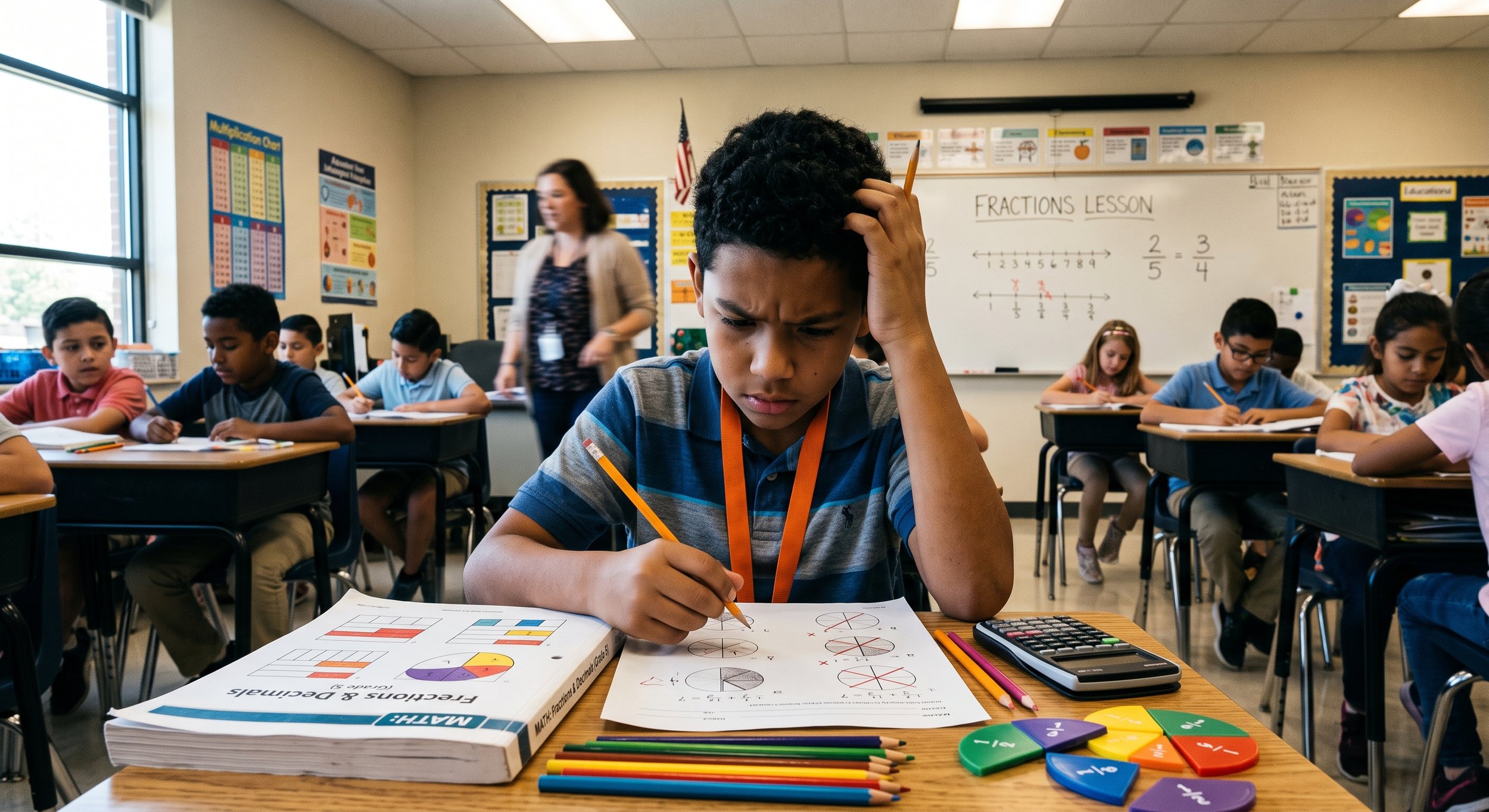
A fresh EdWeek Research Center survey asked educators what's really tripping students up. The answer starts earlier than you might think.
Here's a headline you may have missed in June: national test scores are rising in elementary math. That's genuinely great news! 🎉
But there's a second half to that story. Among middle schoolers, scores have stalled — flattening out after years of decline.
So what's happening in between?
A new EdWeek Research Center survey gives us some real answers, and if you teach 4th or 5th grade, they're worth five minutes of your time.
🔍 What the Survey Found
The EdWeek Research Center surveyed 729 teachers and administrators across the country between January and March of 2026. A few findings jumped out:
44% said their middle school students face severe or very severe challenges in math. That's a bigger share than educators reported for high school, early elementary, or upper elementary. Middle school is where the struggle piles up.
When researchers asked which specific skills students were missing, three rose to the top:
Fractions 🥇
Pre-algebraic skills
Fluency in basic operations
Educators felt much better about other topics — basic geometry and graphing, for example. So this isn't "students are behind in math." It's much more specific than that.
And when asked about the biggest overall challenges in middle school math, educators named a completely different set of problems:
Students not showing up to class
Lack of student engagement
Math anxiety
➡️ Read the full EdWeek article »
🤔 The Part Worth Sitting With
Put those two findings next to each other and something clicks.
The skill middle school educators name first is fractions. But fractions aren't taught in middle school. They're taught in 4th and 5th grade.
Meanwhile, the problems they name — absenteeism, disengagement, math anxiety — aren't knowledge problems at all. They're relationship problems. They describe students who decided somewhere along the way that math isn't for them.
Now, here's something we want to be straight about: relatively few of those educators actually blamed a lack of grounding at the elementary level. Nobody's pointing fingers down the hallway! 🙌
But the skills data tells its own quiet story. The gap they're naming in 8th grade traces back to a unit taught three or four years earlier.
💡 Why Fractions, Specifically?
Fractions hold a strange spot in the math curriculum. They're the first time students meet a number that isn't a count.
Up to that point, math makes physical sense. Three apples. Seven blocks. Twelve minus five. Then fractions show up and the rules flip:
1/4 is smaller than 1/3 — even though four is bigger than three 🤯
You can multiply two numbers and get something smaller than you started with
The strategies that worked for years suddenly stop working
For a lot of students, that's the moment they stop thinking "this is hard" and start thinking "I'm bad at this."
That's why so many teachers describe the fractions unit as the point where students shut down. It's not that the content is impossible. It's that it's the first real conceptual leap — and the students who don't make it start telling a story about themselves that follows them for years.
By 7th grade, that student's transcript reads like a skills gap. It started as a confidence gap.
✨ What This Means If You Teach Upper Elementary
We know that's a lot of weight to put on one unit. But flip it around and there's something hopeful in here.
Upper elementary is the highest-leverage place to intervene. The gap is still small. The story students tell about themselves isn't written yet. A student who finds fractions confusing in October hasn't decided they're "not a math person" — that comes later, after enough repetition.
The tricky part is what to do differently.
Because if the real problem is engagement and anxiety — not comprehension — then the usual fix (more practice problems, more worksheets, more of the same) is aimed at the wrong target. 🎯
You can't drill a student out of believing they're bad at math.
🏀 So What Does Work?
That's the exact question a team of researchers at UC Irvine sat down with back in 2018.
They were talking with teachers about where students struggled most, and the answer came back unanimous: fractions. Teachers called it the moment students started hating math. The school had just repaved its playground — and someone asked a pretty great question:
What if students learned fractions by playing a game on it?
That question turned into Fraction Ball — a team-based math game where students shoot from fraction zones, keep score on number lines, and do continuous fraction arithmetic without a worksheet in sight. It was co-designed with over 20 teachers and studied across four peer-reviewed studies backed by $3.15 million in research funding.
The results:
Students who played improved 25 percentile points on fraction assessments
Researchers also measured more hopefulness and less boredom 💛
That last one might matter just as much as the first. If disengagement is what turns a hard unit into a permanent gap, then moving engagement isn't a nice bonus — it's the whole ballgame.